

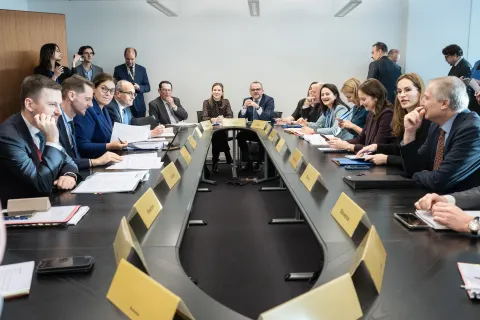
Belgium, Bulgaria, Croatia, Czech Republic, Estonia, Finland, France, Hungary, Italy Netherlands, Poland, Romania, Slovenia, Slovakia, Sweden; Greece and Latvia as observers.
On the margin of the Energy Council of 29th October 2026, the Nuclear Alliance convened to discuss the upcoming post-2030 energy framework. The meeting was attended by ministers and high-level representatives from 17 Member States, as well as by the European Commission. The meeting was chaired by the Belgian Federal Minister for Energy Mathieu Bihet.
Ministers and high-level representatives provided brief updates on key nuclear developments in their respective Member States and held an open discussion on the European energy framework beyond 2030.
The Nuclear Alliance welcomes the upcoming post-2030 European energy framework, which aims to align European energy policy with Europe’s strategic priorities, including energy security, affordability, competitiveness and decarbonisation.
The Alliance stresses that the energy transition is key to strengthening Europe’s strategic autonomy and resilience, achieving structurally lower energy prices, and ensuring a reliable supply of clean, abundant energy to support the economy of the future. Some Alliance members indicated that they are working on new proposals for the next multiannual financial framework for an explicit inclusion of nuclear energy to be discussed in the appropriate fora.
The Alliance members reiterated to the Commission the key messages previously conveyed in June, including that the post-2030 framework must be based on an overarching flexible energy framework with a clean energy target that supports the achievement of cost-effective decarbonisation pathways. They held initial discussions on the priority elements to be included in the post-2030 energy framework to operationalize the clean energy target, including potential approaches to defining clean energy. The members of the alliance underlined that the primary legislation should explicitly recognize that nuclear energy is clean energy.
Furthermore, the Alliance members welcomed the Commission’s follow-up to the Beating Cancer Plan and its recognition of nuclear medicine as a vital component of modern healthcare1, while highlighting that Europe’s leading role in the supply of medical radioisotopes cannot be taken for granted.
Finally they also welcomed the Commission’s cooperation with the OECD Nuclear Energy Agency on “Modelling the European Electricity and Energy System with Renewable and Nuclear Energy Under a Carbon Constraint”, as an important step towards better reflecting the role of both nuclear energy and renewables in the EU’s energy system.
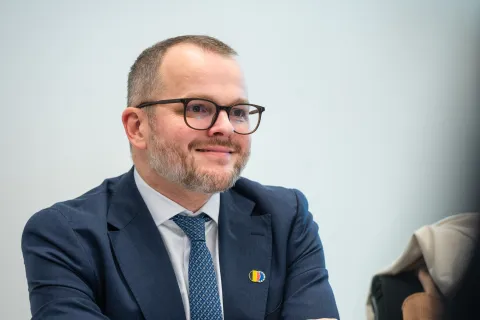
België, dat tot februari 2025 louter waarnemer was van de Nucleaire Alliantie, is vandaag volwaardig lid en zit voor het eerst een ministeriële vergadering voor. Een teken dat ons land weer tot de landen behoort die tellen in Europa op het vlak van kernenergie.
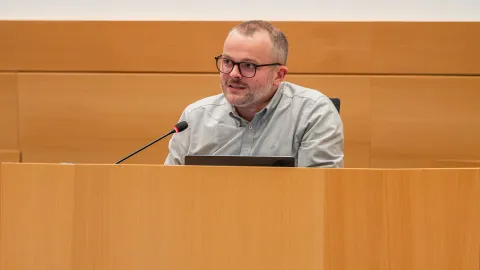
Gelet op de stijging van de stookolieprijzen voorziet federaal minister van Energie Mathieu Bihet om de verwarmingstoelage die wordt toegekend in het kader van het Sociaal Verwarmingsfonds tijdelijk te verhogen. Voor leveringen die plaatsvinden tussen 1 december 2026 en 28 februari 2027zal de tussenkomst worden verhoogd om de kosten boven 1,475 euro per liter op te vangen.
Samenstelling regering
Raadpleeg de samenstelling van de federale regering.